AI Literacy Is Everywhere. Decision Architecture Is Not.
Most AI education for executives focuses on technology literacy, trend briefings, or high-level risk checklists. It explains how models work, showcases emerging use cases, or outlines governance principles. And most of it is designed with large enterprise audiences in mind — assuming dedicated AI teams, large budgets, and established governance infrastructure. What it rarely addresses is the harder question facing most senior leaders today: how should you redesign decision rights, oversight structures, escalation pathways, and accountability systems in an AI-augmented organisation — when you do not have an army of consultants to help you figure it out?
As AI capabilities commoditise, technical access is no longer the differentiator. Judgment is. The organisations that outperform will not be those with “more AI,” but those with better decision architecture layered on top of it. This is as true for a 500-person professional services firm as it is for a global corporation — the pressures are the same, even if the scale is different. Senior leaders — CEOs, CXOs, board directors — are not looking for another course or certification. They need something fundamentally different: a private, self-paced, continuously updated system that helps them think clearly about AI’s impact on strategy, governance, operating models, risk, culture, and capital allocation — in real time, as the landscape evolves.
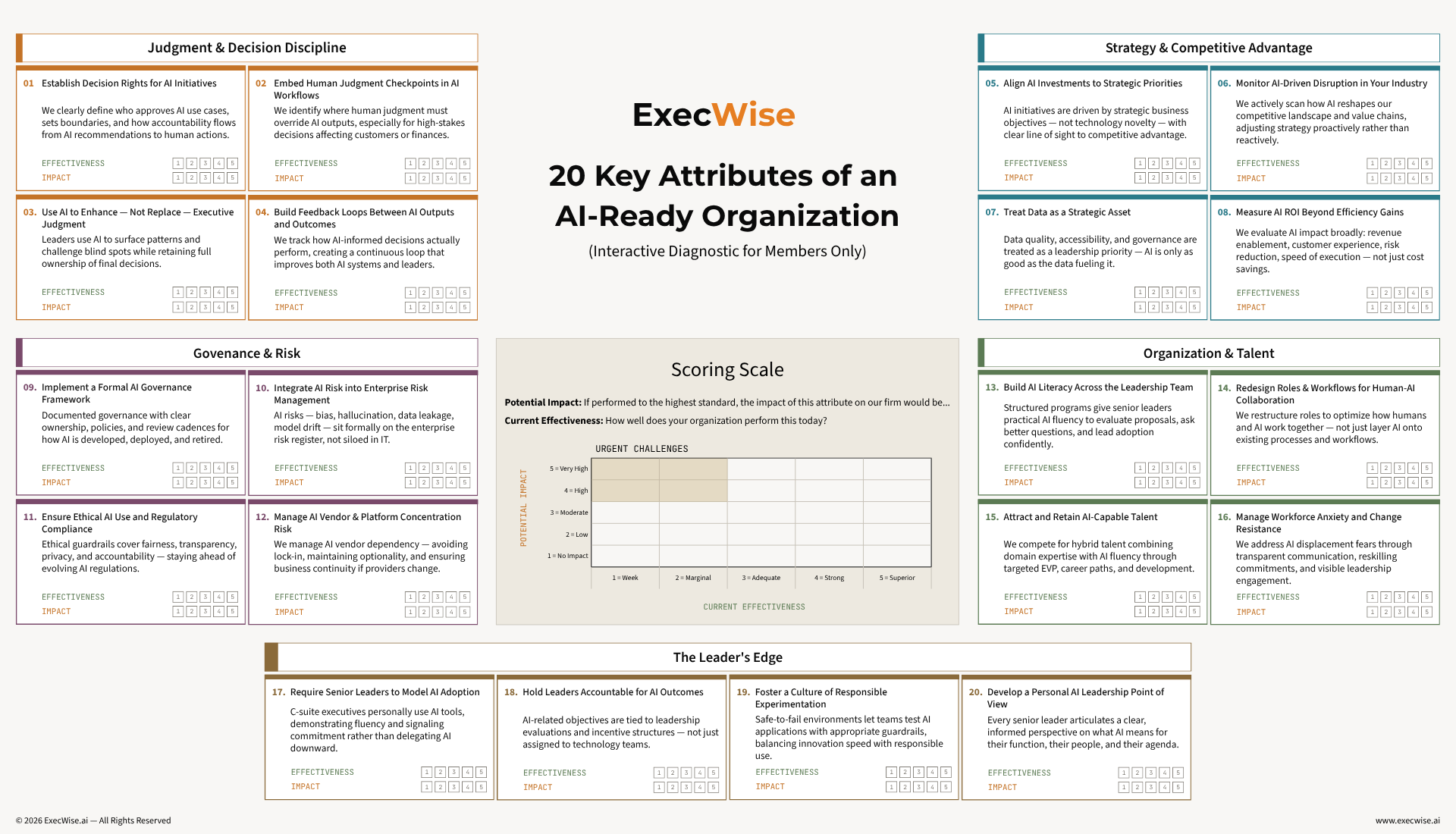
ExecWise exists to operate at that altitude. It is not a content library, a hype digest, or a workforce learning platform. It is a structured decision operating system for executives navigating AI. Every topic is built around real leadership tensions — speed versus oversight, automation versus dissent, adoption versus accountability — and translated into concrete governance mechanisms: how authority should be designed, where override must live, how escalation should function at AI speed, what boards should actually ask, and how to respond when failures occur.
The goal is not to make leaders more informed about AI. It is to make them more disciplined in how they govern it.